Saturday, October 29, 2011

OUR FIRST PALM TREE


Five years ago when we first started construction at Monte Azul, one of our first tree planted was a palm tree. It was placed in the parking area in front of the lecheria. Over the years the palm has continued to flourish. This year it has started to fruit. In early June the first large branch of seeds unfolded from the main trunk. Over a period or weeks the seed branch continued to grow and develop.

About a month later another seed branch unfolded with one more unfolding a month after that. Each branch continues to grow. The first seeds are turning red and have started to drop. The seeds quickly took root in the soil below the tree and have become seedlings. We have moved the first of these to the greenhouse and are now cultivating small palm trees.

The palm tree with the seed branches hanging on the trunk are quite beautiful especially at night when they are illuminated. It has been fun to see this process unfold. I have just discovered that the palm tree in front of Casita Amarilla is about to open its first seed branch. It appears that these palm trees are very happy with the weather conditions at Monte Azul.

Tuesday, October 11, 2011

THE WONDERFUL WORLD OF GUARUMOS


What is a guarumo you might ask? It is a type of tree that is found in tropical zones. It is also known as the Trumpet Tree or scientifically Crecopia. There are 5 species of this tree in Costa Rica. They are all very similar with varying sized leaves, fruits and form of branching.

One of its fascinating traits is that it has a symbiotic relationship with a specific type of ant. These ants live in the hollow parts of the tree and voraciously defend the tree against predators. Walk up to a guarumo and knock on the tree trunk 3-4 times and an army of ants will appears within seconds. Don’t touch the tree because these ants can bite.

The ants also guard the tree against other invasive foliage, a common occurrence in a rain forest. The ants make sure that vines and other plants do not wrap around the tree. I tied a vine around the trunk and the ants immediately attacked it. Voracious biting and eating the piece of vine until it fell off.

The trees are helpful to the forest and other animals too. Guarumos are the first tress to appear in recovering or regenerating forest and can quickly reach their full height or 60-70 feet in just 5-7 years. They have a life span of only 20-30 years during which time they provide the first shade for the slower growing tropical hardwoods. During their short lifetime, they produce a fruit that is enjoyed by a wide variety of birds and mammals. Because of their open growth form, it is not unusual to see sloths, monkeys and birds in these trees.

The leaves of this tree can be quite impressive. Some leaves exceed 3 feet across. They have medicinal purposes and can be used as scouring pads because of their rough durable texture.

The trees on the edges of open areas also have the ability to lean out towards the sunlight. To help stabilize themselves, they send out roots at the base of the trunk to grab the soil and keep them from toppling. From experience, I can attest that this can be a bit dangerous along roads. A few weeks ago, when I was driving one of the “leaning guarumos” broke the passenger side mirror off our car as I was driving. I didn’t realize that the tree was leaning that far out and got a bit too close.

For more information on these trees, check out this website: http://cloudbridge.org/trees/cecropia_polyphlebia.html.

Friday, September 30, 2011

THE NEWEST ARRIVAL AT MONTE AZUL


Last week when our construction crew arrived at work, they told me that they have a surprise. They handed me a bag and told me to be careful. I assumed that they wouldn’t really give me anything “that” dangerous but you never know what other people perceive as dangerous. I willingly took the bag and looked inside. Inside the bag was a turtle.

On their way to work through Chimirol they had spotted a turtle in the middle of the road. This is the main road that runs up the Chirripo Valley. The road is very curvy and can be quite dangerous to an unsuspecting and slow moving turtle. The workers, Cristian and Gerardo, stopped and picked up him. They thought that Monte Azul would be a much friendlier place to reside than along the busy road so they found a travelling bag and put him in the car for his short journey to his new home.

When the turtle was taken out of the bag he was quite feisty. He has a very formidable front tooth that could easily do damage to a finger. He was approximately 8” long from the front to the back of his shell. We set him down on the ground, took a few photos to commemorate his arrival and then watched as he headed towards the creek at the bottom of the hill. He could move quite fast. I hope to see him again one day.

Saturday, September 24, 2011

ANYTHING CAN HAPPEN AT MONTE AZUL…


…AND USUALLY DOES! Last week we had our latest Artist in Residence at Monte Azul, Andrés Cañas. Andrés is a Costa Rican sculptor that lives in San Jose. He has been here several times before and has planned an art installation for Monte Azul using the rocks that are found everywhere on the property.

One his 2nd day at the farm he went out on a rock finding excursion with Paolo, our waiter/barber/bread maker/house painter and heavy lifter…. They took the 1973 Toyota Landcruiser and headed up the valley trail bordering the Chirripó River. They had not been out for long when Carlos and I received a call from them asking for “a little help.”

While driving up the valley, they had apparently gotten a bit too close to the edge of the trail that dropped off into the creek. It was impossible to see this creek because it was covered by plants and forest growth. With all the rain the terrain was very wet and the weight of the car caused the creek’s bank to give way, taking the car with it. So Carlos and I tried to help get the car out but with the wet conditions it really needed much more assistance than Carlos and I ever could provide. We had the enormous fear that the car would tip over and then we would never be able to get it upright, especially since it was full of heavy rocks that had been collected for Andrés’ project.

The next day, our maintenance and kitchen staffs, with the help of a winch, chainsaw, brute force and a little ingenuity were able to free the Toyota from the mud and get it back on the road. It’s worth mentioning that before the heroic liberation, our other car got stuck trying to reach the first one. This car had to be saved first for the simple reason that it was just in the way.

There is always something happening at Monte Azul and you never know what it might be. This event didn’t slow Andrés down though. Like a true Costa Rican, he shook himself off, took it in stride and immediately got back to work on his installation without another thought.

I have attached a sneak peak of this work, any guesses as to what it might be?

Thursday, September 15, 2011

INDEPENDENCE DAY


September 15 is Independence Day in Costa Rica. In 1821, Costa Rica, along with El Salvador, Guatemala, Honduras and Nicaragua (the 5 provinces that formed the Central American Federation) gained independence from Spain. Freedom was declared in Guatemala and began to spread. The news did not arrive in Costa Rica until almost 1 month later – October 13th. Even after the news arrived, Costa Rica did not officially receive its own independence until after a peaceful meeting with the Spanish army on October 29, 1821. However, September 15th is the official Independence Day.

The night before on the 14th, there is the tradition of the Parade of Lanterns, Desfiles de Faroles. This tradition began in Guatemala the evening of September 14th and can be attributed to Dolores Bedoya who ran through the streets of a small town in Guatemala carrying a lantern or farole and shouting “Viva la patria” “Viva la libertad”. She was spreading the news of this independence and calling her fellow townspeople and countrymen to join her in the streets. Lanterns were used because none of these cities or towns had electricity at the time.

This tradition of parading through the streets has been carried out year after year in every small town and city in Costa Rica to reconfirm and declare the continued freedom from foreign rule. However, it was in 1953 that the tradition was officially moved to the local schools and the starting time of 6 PM began.

Children are the centerpiece of the celebration. Children learn to make the faroles in school and at home using all types of materials. The designs can range from simple boxes with Costa Rican designs to elaborate houses with intricate details. All of them include a candle for illumination. For instructions on how to make a simple farol, visit:

http://www.museocostarica.go.cr/en_en/recreo/farol-de-carreta.html

The festival includes traditional dances the parade of the lanterns and the singing of the national anthem. Like all Costa Rican festivals, there is music and lots of food that is made and sold by the local women including the traditional tamales. If you are ever in Costa Rica on September 14th, I urge you to attend one of these celebrations. Like everywhere in this country, all people are welcome. Independence Day here is not just about Costa Rica’s independence from Spain but also about people being free everywhere in the world – Viva la patria, viva la libertad!

Monday, September 12, 2011

LA GRANJA CONTINUES


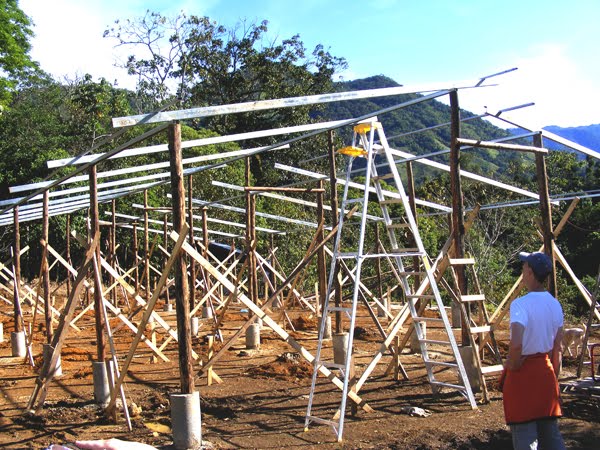
The construction of the new animal barn, La Granja in Spanish, continues. The construction has been delayed by a few obstacles. First there was/is the rain. As the foundations for the support posts were excavated, they quickly filled with rain.. Every morning began with bailing water out of the holes so that the concrete footings could be poured. There are 32 of these foundation holes so it was a slow process.

The next obstacle was the lack of electricity on site. At first the construction relied on hand tools and lots of manual labor. This was not a real problem because the vertical posts are wood. When we started the roof beams it quickly became a problem The roof beams are thick metal. The cordless drill didn’t stand a chance against the thick steel beams. The drill lost its charge after just a few screw holes. So, we brought in a mini generator to construct the roof. In just a few days the beams were up and the metal roof was installed. We are no longer at the mercy of the rains.

We are now beginning the interior spaces. We will begin by dividing the space into separate animal areas. The first to be built will be for the adult and baby goats. I will keep you posted as the progress continues.

Sunday, September 4, 2011

RAPPELLING OR ROCK CLIMBING ANYONE?


Last week when I was working in the studio it started to rain. I didn’t think anything of it. After all it is the rainy season in Costa Rica and it rains in the afternoon. Then, Carlos called me from Café Blue to see if I was OK. Apparently down at Café Blue which is only 300 meters away, quite a storm was in progress. Not only was it pouring but there were also very high winds. Usually when it rains, no matter how hard, the rain comes straight down.

At Café Blue, the winds were gusting, limbs were falling off the trees, chairs were tipping over in the restaurant, glasses were being blown off the tables and crashing onto the stone floor, and a large tree behind the restaurant fell over taking several shrubs, vines and bromeliads with it. All of this while very little rain and no winds were blowing at the studio. Then, across from Café Blue a large wall of vegetation fell from the cliff. This cliff is totally vertical and over the years all types of plants have grown onto this vertical face of rock including trees, vines, flowers, orchids and shrubs. No rock was ever visible.

The wind from this storm loosened the wall of plants and it detached from the rock in one big sheet of twisted plants and roots and fell to the ground, all in one single motion. The result is a perfectly clean rock face of approximately 120 feet tall.

Even before the cleanup of the vegetation began, which included Carlos in his best clothes dragging logs in the rain and Cristobal chopping away with his machete, ideas about setting up rock climbing and rappelling activities began. Adrian the hotel manager was immediately on the phone calling experts to make a site visit while Carlos was emailing a well known rappelling company near Arenal. One of the exciting things about living in Costa Rica is that you never know what will happen and where it will lead you. I will keep you posted on when you can expect to experience rock climbing and rappelling at Monte Azul. Or we may just light it up with pretty lights at night instead.